
Renting vs. Owning a Water Heater in Ontario: An Honest Comparison

Written by Zack Laundrie | Licensed HVAC Technician, Durham Region | Published on July 11, 2026
More Ontario homeowners rent their water heater than in any other province. It’s a habit that goes back decades — water heaters were bundled into new home builds as rentals, and most people never revisited the decision. If you’ve inherited a rental or signed up without doing much math, this post is for you.
Neither renting nor owning is the wrong answer for everyone. But the numbers are worth understanding before you keep paying month after month by default.
How Renting Works
Rental water heaters are common in Ontario because they remove the upfront cost and shift the responsibility for repairs and replacement to the rental company. You pay a fixed monthly fee, and if something breaks, you call them.
Monthly rental rates in Ontario generally run:
- Electric tank: ~$20–$25/month
- Conventional gas tank: ~$25–$35/month
- Power vent gas tank: ~$30–$45/month
- Tankless gas: ~$50–$100+/month
Those rates vary by provider, unit size, efficiency rating, and contract term. Some providers offer 7-year terms, others stretch to 10 or 15 years to advertise a lower monthly number. Installation and service are typically included.
When renting makes sense: If upfront cost is a genuine constraint, or if you’re in a rental property where you’d rather not own the equipment, a rental keeps things simple. The monthly fee is predictable and repairs aren’t your problem.
What Renting Costs Over Time
Where renting gets expensive is the long game. A water heater — tank or tankless — is a long-lived piece of equipment. Tanks typically last 10–15 years, and a quality tankless unit that gets its annual descaling can run 18–25 years. Over that lifespan, monthly rental payments add up significantly.
Using conservative mid-range figures:
Conventional gas tank rental at $35/month:
- 10 years: $4,200
- 15 years: $6,300
Tankless rental at $65/month:
- 10 years: $7,800
- 15 years: $11,700
At the end of that period, you don’t own anything. The unit gets replaced and the payments continue.
It’s also worth noting that rental rates aren’t fixed. Providers can and do increase monthly fees over time — so the number you sign up at isn’t necessarily the number you’ll be paying in year eight. When you own, your cost is known upfront.
What Owning Costs
Purchasing and installing a water heater involves a higher upfront cost, but the math over time looks different.
Here are real installed prices I quote in Durham Region in 2026, equipment and labour included:
- Atmospheric gas tank: ~$1,800
- Power vent gas tank: ~$2,600
- Tankless gas: ~$3,800–$4,200
As an owner, you’re responsible for repairs once the manufacturer warranty expires. Based on what I see in the field, repair costs run roughly $300–$1,200 for a tank and $450–$2,000 on the high end for tankless. Most owners never face a major repair within the equipment’s useful life if the unit was properly installed and maintained.
The ownership break-even on a conventional tank is typically around 5–7 years compared to renting. After that point, every month you own is money you’re not sending to a rental company.
What is your rental actually costing you?
Adjust the sliders to see your real long-term number.
Get a free quote from Zack →
The Tankless Ownership Case
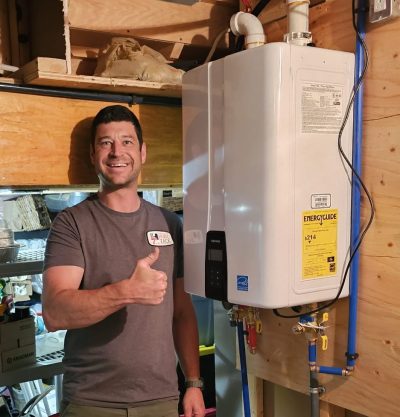
If you’re going to make a move toward ownership, a tankless water heater is worth serious consideration — not as a luxury upgrade, but as a practical long-term decision.
- No standby heat loss. A conventional tank keeps 40–75 gallons of water hot around the clock, whether you’re using it or not. A tankless unit heats water on demand and shuts off when you’re done. For most Ontario households, that translates to a 15–30% reduction in water heating energy costs.
- Lifespan depends on maintenance more than anything else. Here’s what I see in the field: tankless units that never get descaled often need replacement around the 10-year mark — Durham Region’s hard water scales up the heat exchanger and the unit works itself to death. Units that get a simple annual descaling routinely run 18–25 years. If you go tankless, budget for that yearly service from day one; it’s the difference between the shortest-lived and longest-lived equipment in your basement. Tanks are more of a mixed bag: I’ve pulled units at 10 years and seen others still running at 30. Water quality, venting conditions, and whether the anode rod was ever replaced all play a role.
- Unlimited hot water. Tankless units don’t run out. For households with multiple bathrooms or high hot water demand, this is a practical improvement over a tank that can be depleted.
- The upfront cost is real. Tankless installation costs more than a tank — both the equipment and the labour, since gas line sizing, venting, and sometimes electrical work need to be assessed. That’s a straightforward trade: higher upfront cost, lower operating cost, longer life.
For most Durham Region homeowners replacing an aging tank, the long-term economics of a tankless unit owned outright are stronger than either a new tank or a continued rental. It’s not the right fit for every home or budget, but it’s worth pricing out before defaulting to what you already have.
How to Get Out of a Rental Contract
If you’re currently renting and want to switch to ownership, the process is manageable. Ontario’s Competition Tribunal has, since 2014, required major rental providers to allow customers to terminate agreements without unreasonable restrictions. You can terminate by phone, email, or web form — you don’t need an authorization number to start the process.
The general steps:
- Contact your rental provider to request termination and confirm any remaining obligations.
- Arrange removal of the rental unit — you can either return it yourself or have them pick it up.
- Have your new unit installed. A licensed HVAC contractor can coordinate the timing so you’re not without hot water.
Some providers will offer a retention discount when you call to cancel. That’s your call — if the math makes sense, staying put temporarily is fine. If you’re near the end of a contract term, that’s typically the cleanest time to switch.
What to Expect From a Professional Install in Durham Region
Whether you’re installing a tankless unit for the first time or replacing an existing water heater, a proper installation covers more than just swapping equipment.
Gas line sizing matters — a tankless unit requires higher gas flow than a tank, and undersized supply lines affect performance. Venting needs to be assessed and often reconfigured. The condensate from a high-efficiency tankless unit needs to drain somewhere. These aren’t complicated problems, but they need to be handled correctly for the unit to operate safely and at rated efficiency.
I provide free quotes for water heater installation across Durham Region — Oshawa, Whitby, Ajax, Pickering, Bowmanville, and Port Perry. If you’re weighing your options or ready to make a move, a quote conversation takes 15 minutes and gives you actual numbers for your home and situation.