
Tankless Water Heater vs Tank: What Durham Region Homeowners Should Know

Written by Zack Laundrie | Licensed HVAC Technician, Durham Region | Published on June 1, 2026
When a water heater fails or starts showing its age, most Durham Region homeowners face the same decision: replace it with another tank, or switch to tankless. The answer depends on your household, your home’s mechanical setup, and how long you plan to stay — but there is one factor most people in this area are not thinking about clearly, and it changes the math significantly.
Most Durham Region homeowners are not buying their water heater. They are renting it, typically from Reliance or through a utility company, and paying $30 to $50 a month indefinitely. Over ten years that is $3,600 to $6,000 on a piece of equipment that will never be yours and that you will return when you sell your home. Understanding that first is the context for everything else in this comparison.
I install both tank and tankless water heaters across Oshawa, Whitby, Ajax, Pickering, Bowmanville, and Port Perry. Here is what the decision actually looks like from the ground.
How Each System Works
A storage tank water heater does exactly what the name says. It heats a fixed volume of water — typically 40 to 60 gallons in most Durham Region homes — and keeps it hot around the clock. Every time you draw hot water, cold water enters the bottom of the tank and the burner fires to bring it back up to temperature. The energy used to maintain that temperature between uses is called standby loss, and it represents a portion of your gas or hydro bill even on days when nobody is showering or running the dishwasher.
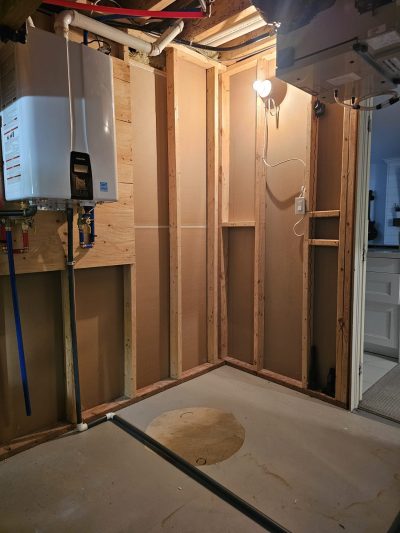
A tankless unit, sometimes called an on-demand water heater, has no storage tank. Cold water passes through a heat exchanger when you open a hot tap, and the burner fires only for as long as you need hot water. When the tap closes, the burner shuts off. There is no standby loss because there is no water sitting in a tank waiting to cool down.
The practical difference for a homeowner is that a tankless system can deliver a continuous supply of hot water without running out, while a tank system has a fixed capacity and a recovery time once that capacity is depleted. For a family of four with overlapping morning showers and laundry running, this matters. For a retired couple in a Whitby bungalow who use hot water at different times of day, it matters a lot less.
What Each System Costs in Durham Region
Tank Water Heater
A standard tank replacement — same venting configuration, same gas connection, straightforward swap — typically runs between $2,600 and $3,500 installed in Durham Region for a 60-gallon residential unit. The lower end reflects a straightforward swap in a newer home with easy access. The upper end covers a power-vented configuration, a larger tank, or an older home where access adds labour time.
Tank water heaters have a lifespan of roughly ten to twelve years with normal use. After that, the anode rod depletes, sediment accumulates, and corrosion risk climbs. Most homeowners in Oshawa and Ajax replace their tank at or before the ten-year mark to avoid the risk of a failure that causes water damage.
Tankless Water Heater
Tankless installation is a larger upfront investment. In Durham Region, most homeowners are looking at $3,600 to $5,000 installed for a gas tankless unit, with the range driven primarily by venting requirements and whether the existing gas line needs to be upsized. A tankless unit draws a significantly higher gas flow rate than a tank — for a short period when hot water is being demanded — and older gas lines in some Whitby or Pickering homes are undersized for that demand. Upgrading the gas line adds cost but is not always required.
The case for tankless is strongest in households with two or more bathrooms in regular use, three or more adults, or any situation where hot water demand runs continuously throughout the morning. Because the unit heats only on demand and never stores water, you are not paying to keep 60 gallons hot overnight or during a workday when nobody is home.
The tradeoff is lifespan. A quality tankless unit, properly maintained with annual descaling in Durham Region’s moderately hard water, will typically last eighteen to twenty-five years. You are paying more upfront for a system that lasts roughly twice as long, operates more efficiently, and never runs out of hot water.
Navien is the brand HVAC Zack installs most frequently for tankless systems. Their condensing units achieve efficiency ratings above 95 percent, which means almost no heat is lost out the exhaust. They are well-suited to Durham Region gas supply pressures and vent in PVC rather than stainless, which keeps installation costs lower than some competing brands. More on what to expect from the installation process is on the water heater service page.
The Rental Question
If you are currently renting a water heater and your rental contract has expired or is close to it, replacing with an owned unit is almost always the better financial decision. A $3,000 tank installation pays for itself in roughly six years compared to a $40 per month rental. A $4,500 tankless installation pays for itself in nine to ten years on rental savings alone, before factoring in the efficiency gains on your gas bill — and you end up with a system that lasts twice as long as the tank you were renting.
When I replace a rental unit for a homeowner in Bowmanville or Port Perry, I handle the return process and they stop paying the monthly fee the day the new unit goes in. Over the remaining years in the home, the savings are substantial — and when they sell, the water heater is a listed asset rather than a rental disclosure.
Replacing a Water Heater or Ditching Your Rental? Get a Free Quote.
HVAC Zack provides water heater installations across Durham Region — no upselling, no pressure.
What Each System Costs in Durham Region
The honest answer is that both systems work well when they are properly sized and installed. The decision comes down to a few practical factors.
Household Hot Water Demand
Tankless systems are rated by flow rate, typically measured in gallons per minute. A unit that can deliver five gallons per minute at a temperature rise of 45 degrees Celsius is sized for a typical Durham Region detached home. The concern with undersized tankless systems is that simultaneous demand — two showers and a dishwasher running at the same time — can exceed the unit’s capacity and result in lukewarm water. A properly sized unit eliminates this problem, but sizing matters more with tankless than with tank systems where a large enough tank simply buffers the demand.
For families with high simultaneous demand, a larger tankless unit or a correctly sized tank are both valid options. For households with sequential rather than simultaneous demand, tankless is almost always the better choice on efficiency grounds.
Your Home's Mechanical Setup
Tank water heaters are generally simpler to replace because the existing venting and gas connections are already sized for them. A straight tank swap in a newer Ajax or Bowmanville home with a dedicated mechanical room is a two to three hour job with minimal disruption.
Tankless requires venting to the outdoors, typically through PVC pipe run horizontally through an exterior wall or vertically through the roof. Homes where this routing is straightforward — a utility room on an exterior wall, for instance — are easy candidates for tankless conversion. Homes where the mechanical room is in the centre of the house with no direct exterior wall access require longer venting runs that add some complexity and cost.
How Long You Plan to Stay
If you are planning to sell within two or three years, a tank replacement is usually the more sensible financial choice. The upfront cost is lower, the installation is simpler, and the buyer gets a functioning water heater without the premium for a tankless upgrade they may or may not value.
If you are staying for five years or more, the calculus shifts toward tankless, especially if you are currently on a rental contract. The combination of rental savings and efficiency gains over a ten to fifteen year period typically exceeds the premium on the tankless installation.
Maintenance: What Each System Needs
Tank water heaters require relatively little maintenance. Flushing the tank annually to remove sediment extends its life and keeps efficiency up. Checking the anode rod every three to five years and replacing it before it depletes fully can add years to the tank’s lifespan. Most homeowners in Durham Region skip both of these, which is part of why tank replacement at ten to twelve years is so common.
Tankless water heaters need annual descaling in Ontario because the province’s moderately hard water causes mineral buildup in the heat exchanger over time. This is a straightforward service job — typically under an hour — and a tankless unit that gets annual descaling will hit its full lifespan potential with few problems. A tankless unit that never gets descaled will start to underperform and can fail prematurely. If you are switching to tankless, budget for annual maintenance from day one.
Durham Region’s water hardness is moderate — generally in the 100 to 200 mg/L range depending on the municipality — which means descaling is genuinely necessary but not as urgent as it would be in a very hard water area. If you are in a part of Oshawa or Whitby on municipal supply, your water report is available from the Region of Durham water quality page and can help your technician assess how frequently descaling is needed.
A Third Option Worth Mentioning: Heat Pump Water Heaters
Heat pump water heaters are the right conversation for homeowners who do not have access to natural gas — typically rural properties in Durham Region that are on propane, or homes that have never had gas service run to them. Rather than generating heat directly the way an electric resistance tank does, a heat pump water heater moves heat from the surrounding air into the water using refrigerant, the same principle behind a heat pump for home heating. The result is a unit that uses significantly less electricity to produce the same volume of hot water compared to a conventional electric tank.
Navien makes a 50-gallon heat pump water heater that HVAC Zack installs for customers in this situation, typically ranging from $3,500 to $5,500 installed depending on the electrical setup and location. For a homeowner currently paying propane prices to heat water, the efficiency gain is meaningful and the running cost comes down considerably. Ontario’s Home Renovation Savings Program currently offers a rebate toward qualifying heat pump water heater installations — the HRS program details are worth reviewing if you are on electric or propane water heating.
One practical requirement: the unit needs to be installed in a space that stays above roughly 10 degrees Celsius year-round, typically a basement or mechanical room. It also draws heat from the surrounding air, which has a slight cooling effect on the room it is in — useful in a basement that runs warm, less so in an already cold utility space. For the right home and the right situation, it is the most efficient water heating option available.
Signs Your Current Water Heater Is Due for Replacement
Running out of hot water faster than you used to is one of the clearest signs that sediment has reduced your tank’s effective capacity. A 40-gallon tank with six inches of sediment is effectively a 30-gallon tank, and you will feel that when the morning rush hits.
Discoloured or rust-tinted hot water points to a depleted anode rod and active corrosion inside the tank. Once the anode rod is gone, the steel tank wall is exposed to the water and the clock is running on a leak. This is worth acting on quickly rather than waiting for the failure.
Any pooling water around the base of the unit is a failed tank, not a loose fitting. Tanks do not get repaired — they get replaced. If you see water on the floor around your water heater in Ajax or Pickering, the unit needs to come out the same day to avoid water damage to the surrounding structure.
Rumbling or popping sounds during the heating cycle indicate hardened sediment at the bottom of the tank. On a unit under eight years old, a thorough flush can sometimes resolve this. On a unit over ten years old, it is a sign the replacement conversation should happen now rather than after a failure. The water heater service page has a full breakdown of the signs that indicate replacement versus repair.
If you are in Oshawa, Whitby, Ajax, Pickering, Bowmanville, or Port Perry and your water heater is showing any of these signs, getting a quote before the failure happens puts you in a much better position than calling on a Saturday morning when the basement floor is wet.
Time to Replace Your Water Heater?
Own It Outright — No Rental Contracts.
HVAC Zack provides water heater installations across Durham Region — no upselling, no pressure.
About The Author
Zack Laundrie is a licensed and insured HVAC technician with over 15 years of hands-on experience serving Durham Region homeowners. He specializes in heat pump installation, hybrid systems, and honest diagnostics across Oshawa, Whitby, Ajax, Pickering, Bowmanville, and Port Perry.