
Gas vs. Heat Pump: What It Actually Costs to Heat Your Oshawa Home in 2026

Written by Zack Laundrie | Licensed HVAC Technician, Durham Region | Published on April 2, 2026
If you’re comparing a furnace to a heat pump and wondering whether switching makes financial sense, the honest answer comes down to one number: how much does it cost to move one unit of heat into your house? Not the sticker price of the equipment. Not vague promises about efficiency. The actual dollar figure on your bill, every month.
Let’s do the math for Oshawa and Durham Region using real 2026 rates.
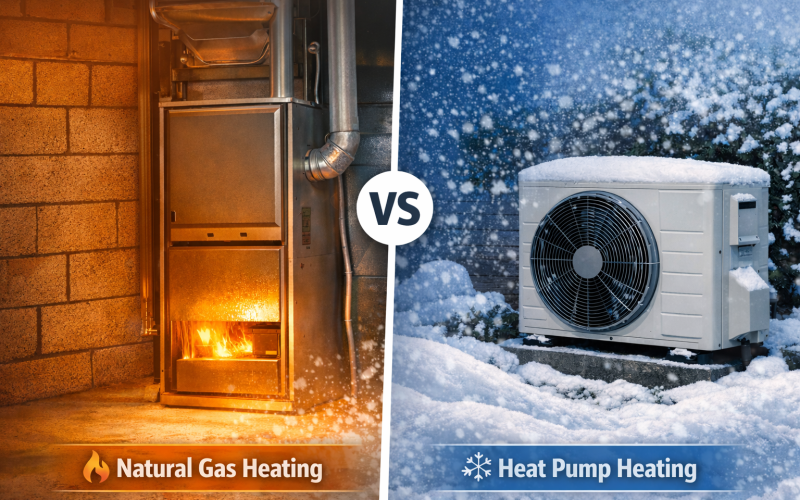
What You're Actually Paying For: Heat Energy, Not Fuel Volume
Your furnace burns natural gas measured in cubic metres (m³). Your heat pump runs on electricity measured in kilowatt-hours (kWh). To compare them apples-to-apples, we need to convert both into the same unit of heat energy: the gigajoule (GJ).
Here’s what that looks like right now:
| Fuel | Current rate | Energy content | Cost per GJ delivered |
|---|---|---|---|
| Natural gas (Enbridge, Apr 2026) | ~$0.31–$0.33/m³ all-in* | ~38.4 MJ/m³ | ~$8–$10/GJ (at 95% furnace efficiency) |
| Electricity — TOU off-peak | 9.8¢/kWh | 3.6 MJ/kWh | ~$27/GJ (COP 1.0) or ~$11/GJ (COP 2.5) |
| Electricity — Tiered Tier 1 | 12.0¢/kWh | 3.6 MJ/kWh | ~$33/GJ (COP 1.0) or ~$13/GJ (COP 2.5) |
* Enbridge all-in rate includes gas supply charge, delivery, transportation, and monthly customer charge prorated over typical 2,400 m³/year usage. As of April 1, 2026, Enbridge reduced bills by $56–$136/year depending on location. Rates adjust quarterly, so always check enbridgegas.com for current figures.
The COP Factor: Why a Heat Pump Can Beat Gas on Electricity Rates
A gas furnace running at 95% AFUE turns 95 cents of every gas dollar into heat. Efficient, but capped at 100%.
A cold-climate heat pump doesn’t burn anything. It moves heat from outside air into your home. For every unit of electricity it uses, a quality unit might deliver 2 to 3 units of heat on a typical Oshawa winter day (above about -10°C). That ratio is called the Coefficient of Performance, or COP.
That’s the whole game. When a heat pump runs at COP 2.5, it’s delivering heat at roughly half the energy cost of direct electric resistance, which is why the comparison to gas gets interesting.
Want a Properly Sized Heat Pump Installation in Durham Region?
HVAC Zack sizes every system with a real heat loss calculation — not a square footage guess.
Call or request a quote to get started.
Real-World Heating Season Math for a Typical Oshawa Home
A typical 1,800–2,000 sq. ft. Durham Region home uses roughly 2,000–2,400 m³ of natural gas per year for heat and hot water. Stripping out water heating, space heating accounts for approximately 1,500–1,800 m³.
| Scenario | Annual heat used | Est. fuel cost (heating only) |
|---|---|---|
| High-efficiency gas furnace (96% AFUE) | ~1,600 m³/yr | $530–$640/yr* |
| Heat pump, avg. COP 2.2 (hybrid, Oshawa winters) | ~5,500–6,000 kWh/yr | $660–$720/yr (Tier pricing)** |
| Heat pump, avg. COP 2.5 (mild-to-moderate days) | ~5,000 kWh/yr | $600/yr (Tier pricing)** |
| Electric baseboard (COP 1.0, worst case) | ~14,000 kWh/yr | $1,680+/yr |
*Gas estimate uses ~$0.33/m³ all-in Enbridge rate (EGD Rate 1, April 2026). **Electricity estimate uses 12.0¢/kWh Tier 1 rate. Delivery charges not included in either; both fuels carry delivery costs on top of commodity. Hybrid systems will use less electricity because the furnace handles deep cold days.
What Drops a Heat Pump's COP in Oshawa Winters
This is the part that matters for Durham Region specifically. A heat pump’s COP isn’t a fixed number. It drops as outdoor temperatures fall. Most cold-climate units are rated down to -25°C to -30°C, but efficiency decreases the colder it gets.
How COP changes with outdoor temperature (Oshawa)
| Above 5°C | COP 3.0–4.0 | Heat pump clearly cheaper than gas |
| Around −5°C | COP 2.0–2.5 | Still competitive with gas |
| Around −15°C | COP 1.5–2.0 | Approaching gas cost parity |
| Below −20°C | COP < 1.5 | This is why hybrid systems win in Durham Region |
Oshawa averages roughly 15–20 days per heating season below -15°C. A properly configured hybrid system (heat pump + gas furnace with a balance point lockout setting) lets the heat pump handle the cheaper work and hands off to the furnace when it makes more sense economically. That’s the setup we recommend for most Durham Region homes.
The Hidden Costs That Swing the Math
Running-cost comparisons don’t tell the whole story. A few things to factor in:
- Delivery charges: Both gas and electricity carry fixed delivery costs. Enbridge’s residential customer charge is ~$27.69/month as of early 2026, regardless of how much gas you use. Electricity has delivery charges too, typically 25–30% of your total hydro bill. Neither side is free of fixed costs.
- Equipment maintenance: Gas furnaces require annual servicing and heat exchangers have a finite life. Heat pumps have fewer combustion components but need refrigerant checks and coil cleaning.
- Electricity rate plan: If your household can shift heat pump operation to off-peak hours (9.8¢/kWh on TOU), the math improves meaningfully versus the Tier 1 rate of 12.0¢/kWh. The Ultra-Low Overnight (ULO) plan at 3.9¢/kWh overnight is worth exploring if you have a smart thermostat and flexible usage.
- Ontario Electricity Rebate: The provincial OER is currently 23.5% (as of November 2025), applied to your pre-tax electricity bill. This meaningfully offsets heat pump running costs.
So Which Is Cheaper Right Now: Gas or Heat Pump?
In Oshawa in 2026, a well-installed cold-climate heat pump running in hybrid mode is roughly cost-competitive with a high-efficiency gas furnace for space heating, and may come out slightly ahead on milder days, which make up the bulk of the heating season.
What tips it in favour of the heat pump: low electricity rates (off-peak or OER-discounted), a well-insulated home with proper duct airflow, and a hybrid setup that avoids running the heat pump in deep-cold conditions where COP drops.
What tips it in favour of gas: homes with poor insulation that require constant heating, or homes not yet on a smart rate plan. If your duct system is undersized or your home loses heat quickly, both systems suffer. Gas is just more forgiving.
The honest answer is: either system, if properly sized and installed, will cost a similar amount to operate in a Durham Region climate. The bigger driver of your bill is often duct condition, insulation, and thermostat settings. Not which fuel you chose.
Want Numbers for Your Specific Home?
The calculations above use averages. Your house has a specific heat load, duct system, and usage pattern. When we quote a system (whether hybrid, standalone heat pump, or furnace), we run the actual numbers for your home and show you what to expect on your bills.
Give us a call or fill out the quote form and we’ll give you a straight answer, not a sales pitch.
Related pages on HVAC Zack:
Heat Pumps — hvaczack.ca/heat-pumps/
Heat Pump Cost in Ontario: 2026 Guide — hvaczack.ca/heat-pump-cost-ontario/
Furnace Install & Repair — hvaczack.ca/furnace-install-repair/
Financing — hvaczack.ca/financing/
Ready to Book a Heat Pump Installation in Durham Region?
Call or request a free quote.
HVAC Zack provides licensed, insured, properly commissioned heat pump installs across Durham Region.
About The Author
Zack Laundrie is a licensed and insured HVAC technician with over 15 years of hands-on experience serving Durham Region homeowners. He specializes in heat pump installation, hybrid systems, and honest diagnostics across Oshawa, Whitby, Ajax, Pickering, Bowmanville, and Port Perry.