
Is Your AC Ready for a Durham Region Summer? What to Check Before the Heat Hits

Written by Zack Laundrie | Licensed HVAC Technician, Durham Region | Published on April 27, 2026
Durham Region summers don’t give you much warning. One week you’re wearing a jacket, and the next you’re running the AC at 11pm hoping it keeps up. The problem is that most air conditioners that are going to struggle this summer are already struggling right now — they’re just not being asked to work hard enough yet for anyone to notice.
Late April and early May is the best time to find out whether your system is ready, because it’s the only stretch of the year where you can book a tune-up without waiting days for someone to show up. Once June hits and temperatures climb, every HVAC company in Durham Region is dealing with emergency calls. If something is wrong with your AC, you want to know before that, not during a heatwave on a Friday afternoon.
This guide walks through what’s worth checking yourself, what a professional tune-up actually covers, and how to know whether your system is worth servicing at all or whether this is the spring you replace it.
Why Spring Is the Only Time This Makes Sense
If you called for AC repair or maintenance in July, you’d likely be waiting. The season compresses everything. Technicians are booked, parts occasionally have to be ordered, and you’re sitting in a house that’s 30 degrees while all of that plays out.
The homeowners who avoid that situation are the ones who test their system in April or early May, while the weather is still cooperative. If the diagnosis comes back clean, great. If something needs attention, there’s time to order a part, schedule a second visit, or assess whether the repair makes financial sense before the heat is on.
There’s also a practical cost difference. A spring tune-up on a system that’s been sitting since September is almost always less expensive than a reactive service call in peak season. You’re not paying urgency pricing, and you’re not paying to troubleshoot a system that’s failed under load.
What You Can Check Yourself Before Calling Anyone
Not everything requires a technician. There are a few things worth doing yourself before booking a service call, because they’re genuinely useful checks and they might save you money.
Start with the filter: If your furnace filter hasn’t been changed since the heating season ended, change it now. A dirty filter restricts airflow across the evaporator coil, which forces the system to work harder and can cause the coil to ice over. This is one of the most common reasons homeowners call for AC repair in June, and it’s entirely preventable. A clogged filter won’t show up as a problem on a cool spring day, but it will absolutely cause trouble on a 32-degree afternoon.
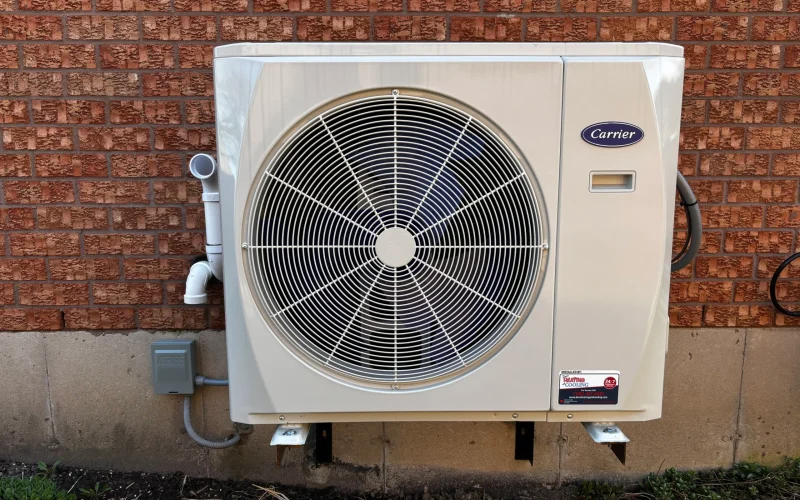
Clear the outdoor unit: The condenser unit outside spent the winter collecting leaves, cottonwood, grass clippings, and general debris. Walk around it and remove anything that’s accumulated against the fins or within about two feet of the unit. You don’t want to hose it down while it’s running, but a gentle rinse with a garden hose when it’s off can clear surface dirt from the fins. Good airflow around the outdoor unit is essential for the system to shed heat properly.
Test it on a warm day: Once you have a day in the high teens or low twenties, run the AC for 15 to 20 minutes and check whether the air coming from your vents is noticeably cooler than the air in the room. It won’t cool the house dramatically at that temperature, but you should feel cold air at the registers. If the air feels lukewarm, or if the system runs continuously without dropping the indoor temperature at all, something’s off and it’s worth getting a professional to look.
Check that nothing is obviously wrong: Listen for grinding, squealing, or rattling that wasn’t there before. Check that the outdoor unit is level (frost heave can shift the pad over winter). Make sure the breaker for the AC circuit hasn’t tripped.
If everything looks and sounds fine after these checks, your system may genuinely be in good shape. A professional tune-up still makes sense if the unit is older than five or six years or if it’s never been serviced, but at least you’ve ruled out the obvious issues.
Ready to Book a Spring AC Tune-Up in Durham Region?
Call or request a free quote.
HVAC Zack provides honest AC inspections and maintenance across Durham Region — no upselling, no pressure.
What a Professional AC Tune-Up Actually Covers
There’s a version of an AC “tune-up” that’s really just a sales visit: someone shows up, does a visual check, tells you everything looks fine, and leaves. That’s not what a proper seasonal inspection looks like.
A real tune-up should cover refrigerant pressure, which is the most important check on the list. If refrigerant is low, there’s a leak somewhere. A system running low on refrigerant works harder, struggles to cool on hot days, and puts extra strain on the compressor over time. Low refrigerant doesn’t declare itself with an obvious symptom on a mild day; it shows up as a system that just barely keeps up when temperatures hit 30.
Beyond refrigerant, the inspection should include cleaning the condenser coils (the outdoor unit), checking the capacitor and contactor, testing the blower motor and drain line, verifying electrical connections and amperage draws, and checking the thermostat calibration. Each of those components can degrade quietly and then fail at the worst possible moment.
If a technician finds something, you should get a straight answer on whether it’s worth fixing. A capacitor replacement is a minor repair. A failing compressor on a 15-year-old unit is a different conversation entirely. When it comes to older systems, there’s a clear point where the repair cost crosses into replacement territory, and a good technician will tell you honestly where you stand instead of pushing you toward whichever outcome benefits them.
When This Might Actually Be a Replacement Conversation
Most AC systems in Durham Region have a lifespan of 15 to 20 years. If yours is pushing past that range and has had a significant repair in the last few years, spring is a good time to assess whether it makes sense to keep repairing it.
The math is straightforward. If a repair costs more than roughly a third of what a new system would cost, and the existing system is already aging, replacement usually wins on a five-year basis. A new central air conditioner will be more efficient, will come with a warranty, and won’t put you in a position of waiting for another part to fail at the start of next summer.
The other scenario worth considering is if your home doesn’t currently have central air conditioning at all or is running window units. Installing central AC in Durham Region is a one-time disruption that pays off for years, and spring is genuinely the best time to have the work done before the season starts.
If you’re weighing a straight AC replacement against upgrading to a heat pump, that’s also a reasonable conversation to have this time of year. A heat pump handles both cooling in summer and heating in fall and spring, and depending on your current setup, it may be eligible for rebates through Ontario’s Home Renovation Savings Program that offset a meaningful portion of the installation cost. It’s not the right choice for every home, but it’s worth asking the question before committing to a straight like-for-like AC replacement.
The Call I Get Every July
There’s a pattern that plays out every summer across Durham Region. A homeowner noticed in May that the AC wasn’t quite right. Maybe it was cycling on and off too frequently, or the upstairs never cooled below 24 degrees, or there was a faint noise that wasn’t there the year before. They made a mental note to deal with it, and then summer got busy.
By late July, the system stops keeping up entirely, or it fails outright on the hottest weekend of the year. I get that call and do what I can to get there quickly, but the reality is that the repair could have been done in May for less money and less stress, and the homeowners wouldn’t have spent two weeks barely tolerating a house that stayed at 28 degrees.
The point of a spring tune-up isn’t to generate a service call for its own sake. It’s to catch the things that are quietly degrading before they become emergencies. A dirty condenser coil that’s robbing the system of efficiency in May becomes a failing compressor by August. A capacitor that tests weak in April doesn’t make it to Labour Day. Catching those things early is almost always cheaper and less disruptive.
Serving Durham Region From Oshawa to Port Perry
HVAC Zack provides AC repair and maintenance across Durham Region, including Oshawa, Whitby, Ajax, Pickering, Bowmanville, and Port Perry. Spring availability is significantly better than summer. If you’ve been meaning to get your system looked at before the heat season, now is the right time to book.
Call or text (705) 344-3124, or get a quote online.
Frequently Asked Questions
How often should an air conditioner be serviced?
Once a year is the standard recommendation, ideally in spring before the cooling season. If your system is older than ten years, annual service is especially worth doing because it catches component wear before it becomes a failure.
What does an AC tune-up cost in Durham Region?
Pricing varies depending on the system and what’s found, but a standard inspection and tune-up is typically in the range of $100 to $175. If repairs are needed, the service call fee is usually applied toward the repair cost.
My AC worked fine last summer. Do I still need a tune-up?
Not necessarily. If the system is relatively new, was serviced last year, and your checks look normal, you may be fine. That said, refrigerant leaks and capacitor degradation happen gradually and don’t always show symptoms until the system is under full summer load. A quick inspection gives you confidence going into the season.
Can I add refrigerant myself?
No. Refrigerant handling requires certification in Canada. If your system is low on refrigerant, there’s also a leak that needs to be found and repaired before adding more, otherwise it will just be low again in a few months.
Should I replace my AC or fix it?
It depends on the age of the system and the cost of the repair. A system under ten years old is generally worth repairing unless the repair is major. For systems over 15 years old, it’s worth comparing the repair cost against the cost of a new installation before committing. HVAC Zack provides honest repair-vs-replace assessments on every service call.
Is a heat pump a good alternative to a new AC?
For many Durham Region homes, yes. A cold-climate heat pump provides the same summer cooling as a central AC and also handles shoulder-season heating efficiently. Learn more about heat pump installations in Durham Region and whether yours could be a good candidate.
Is It Time to Replace Your AC? Let's Find Out.
Not sure whether to repair or replace?
HVAC Zack will give you a straight answer on the service call — and a quote on a new system if it makes sense.
About The Author
Zack Laundrie is a licensed and insured HVAC technician with over 15 years of hands-on experience serving Durham Region homeowners. He specializes in heat pump installation, hybrid systems, and honest diagnostics across Oshawa, Whitby, Ajax, Pickering, Bowmanville, and Port Perry.